
16 June 2026
Kirsty Knowles, University of Dundee
Sunday evening
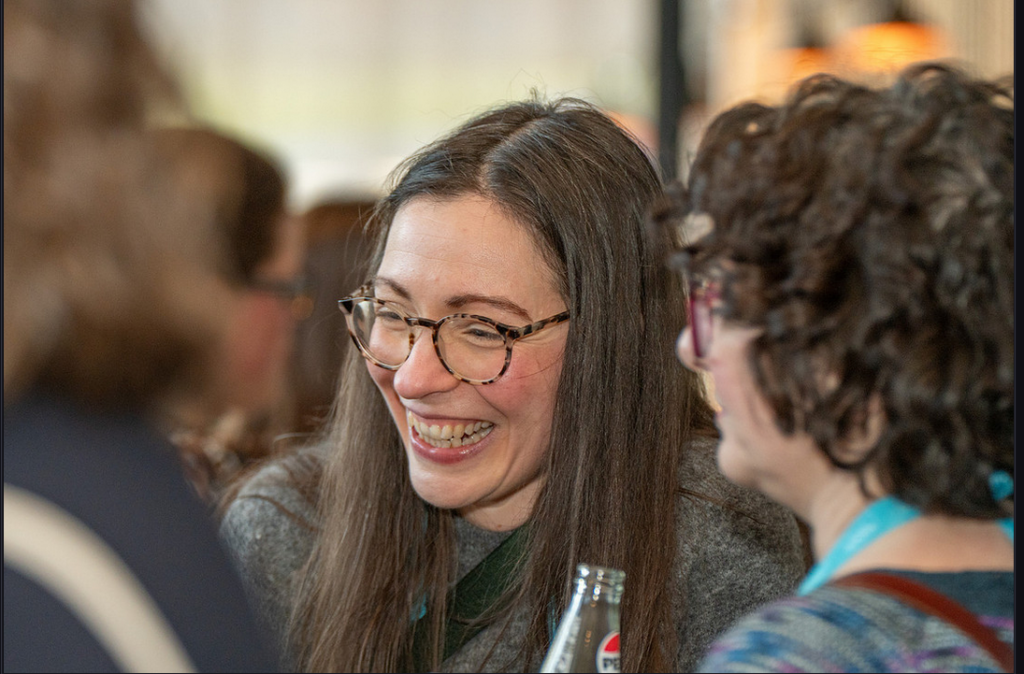
First-timers’ welcome reception
After dodging puddles and escaping the sudden downpour Glasgow was offering, the warm welcome received at the first-timers’ reception felt all the better. It was a relaxed and cheerful environment which made connecting with new people an ease. There is a picture captured by the event’s photographer that illustrates how much I enjoyed the evening – I bet if you looked, you would find it!
Monday
Standout sessions
The opening plenary ignited the way for a determined and powerful conference line- up. Colleagues of Lancaster University, Andrew and Tom, paid a deeply moving tribute to Elaine Sykes. A perfect example of how passionate and courageous the library community is, and how collectively, we can try for a better future ahead.
If we want open access for books, we must find more diverse and affordable publishing options to achieve this.
What will I do now?
As quoted from Elaine, ‘courage in crisis’. Where you publish can be seen as important and a proxy for quality. This ‘prestige’ is now associated with an extremely (over)priced charge which library budgets are buckling under. As librarians and scholarly communicators, we need to partner with authors and dispel misconceptions around open access publishing for books. Now more than ever, fostering greater community involvement will strengthen curating and sharing of equitable academic publishing practices, whilst giving us the opportunity to invest in open infrastructure in attempts to respond to the ongoing systemic challenges faced by university libraries. Let us not tread the same weather-worn path as before, it is not the only viable route.
Diamonds do not fade!
Tying into the urge for diversity in publishing models, the Dutch universities panel share how they have created a diamond/open access innovation fund which supports diamond initiatives, both in content and in infrastructure.
Make investments that reflect commitment.
What will I do now?
Inspired by TU Delft‘s panellist, Louise Otting, who invest in non-profit collections and infrastructure with saved budget from ‘big deals’ cancellations. I hope to play my part, to help shape future ways of thinking and how we can utilise our library budget effectively and with the view to implementing sustainable and equitable resources and content for our library users.
Tuesday
Highlights
A topic that many colleagues in university libraries and higher education institutions (HEIs) grapple with on the daily, the ‘big five’ negotiations, started off day two. Looking beyond and reflecting upon lessons learned in times of such radical uncertainty highlighted the serious challenges we face. Listening to the panel members, Chris Banks, Anna Vernon, Kirsty Lingstadt, Gary Steele, and Alastair Flett reflect on their experiences gave an honest and complementary message of what needs to be the focus now: collective cooperation, from funders, publishers, institutions in research integrity, alongside clear consistent data transparency, both in terms of current costings and legacy pricing. There are umpteen disparities across commercial publisher data hindering effective and solid decision-making.
Not only that, I agree with what was said about current pathways, at least in terms of these negotiations, triggering fragmentation. Fragmentation not just for smaller HEIs, but for community-based publishing. It would be ideal, especially given recurring budget cuts, to see Jisc‘s energies going equally into actively supporting collective funding, community-led publishing alternatives. These packaged ‘deals’ are too expensive, with tensions growing between what is being offered, i.e. AI-layered tools, and what it is that authors and institutions actually want. Linking back to research integrity, until we see commercial publishers’ ethics around editorial, peer review, copyright practices improve and progress positively, we do not want to shell out eyewatering amounts for a large amount of content with no real visible oversight of pre-publication workflows and practices. [More there should be an option and the ability to pay for content, and any ‘add-ons’ should be optional]
The next plenary session on library disaster preparedness in US libraries amplified that public and academic libraries and librarians play a physical and vital role to its communities, in this case, during weather-related disasters. But a recurring problem crops up again: the requirement and need for sustainable and accessible infrastructures to be invested in and supported financially in order to provide an effective long-term service to communities that utilise resources and the need for these to be invested in and supported financially in order to host reliable, accessible resources for such times.
Simon Bowie’s lightning talk was sound and practical, steering the importance of community-led initiatives in university libraries, emphasising that there is no open access without the investment of in-house technical developers to maintain open infrastructures.
What will I do now?
Due to my institution’s current financial situation, professional services including Library services have lost many of their workforce. I feel, now more than ever, fostering greater collaboration across teams will strengthen our offerings, whilst giving us the opportunity to invest in open infrastructure like, open educational resources.
Wednesday
Highlights
“The storm is real”. In a data-dependent world, where global priorities are disjointed, active digital preservation has become an essential strategy to prevent the erosion of the scholarly record, and to save digital outputs from vanishing. A wonderfully powerful call-to-action plenary presented by Alicia Wise and a topic which I can relate to. Act locally, create preservably, and collaborate maximally.
Digital fragility is strategic fragility.
What will I do now?
I will advocate for long-term preservation solutions and seek to have them embedded into our Library’s strategy. Too frequently now content is being taken down or disappears, which I have experienced recently with a project. My small step is to implement an open source platform to resurface the retrieved content and reflect on this experience when planning future projects.
Being mindful of not running before we can walk, at the start, there must be a standard of how we archive documentation, especially PDFs, and it should be a well-known process across teams and departments, with cross-collaboration.
It was inspired to hear that the University of Edinburgh throughout departments and services, such as Human Resources, must comply with the University’s preservation strategy.
My last session of the conference was from Dal Badesha and Coventry University’s truly ambitious project to replace costly textbooks with open educational resources (OER) through a partnership with Sylla. Not only did the project look to replace what is seen as a traditional route to acquiring module and learning content, but they treated the OER project as a cultural shift, towards a sustainable, student-centred model. The figures reflected the positive impact which the implementation had on the student population, further supported by evidential data of active student engagement of OER chapters with incorporated teaching notes. Essential learning materials are being provided to every student while making huge savings to dwindling library budgets. A truly inspired partnership – thank you for sharing so openly, Dal!
What will I do now?
Follow in the footsteps of the Coventry and Sylla partnership, and look to begin the transition of our content shifting from closed to open, and taking on board the recurring themes mentioned throughout the conference: sustainability, digital preservation, open infrastructure, non-profit equitable publishing models. It would be wonderful if cross-institutional collaboration came out of this to support longevity.
Sponsored place
Jove sponsored my place at this year’s conference which I am truly appreciative of. Without such support being offered, albeit to a lucky few, this opportunity would have been simply inaccessible, particularly now that the sector is making budget cuts in all areas including professional development of staff. I hope that future UKSG conferences will expand their sponsored places offering for those who do not fit into existing applicant categories.