
18 November 2025
Summary of the UKSG Online Seminar: Understanding Resource Discovery: Archives and Primary Sources Content (11–12 November 2025)
Getaneh Alemu, Cataloguing & Metadata Librarian, Southampton Solent University
Event details: https://www.uksg.org/events/rd25/
I was invited by UKSG to present at an online seminar scheduled for November 11–12, 2025. The seminar, moderated by Anja van Hoek from Amsterdam University Press and Magaly Taylor from Gale, Cengage Group, focused on the importance of accurate, consistent and standardised metadata descriptions. It also addressed how modern discovery interfaces and AI tools can enhance the visibility and accessibility of primary and archival collections.
Day One: 11 November 2025
After an introduction by Magaly Taylor outlining the seminar’s aims, I was the first presenter on “The Role of Metadata for Archival Discovery.” Based on my co-authored paper with James Clark, “Metadata and archival discoverability: driving use of the Philip Mackie collection at Southampton Solent University,” I highlighted the importance of metadata quality indicators and the need for structure, consistency and accuracy. I reviewed key archival standards such as ISAD(G), EAD and LCSH and their roles in creating interoperable and reusable metadata.
Using the Philip Mackie Collection at Solent University Library as a case study, I demonstrated how describing the archive with ISAD(G) and EAD using JISC’s EAD Editor, then publishing it on the Archives Hub and cross-linking it to Wikidata, has improved its visibility across these platforms. To further enhance discoverability, James Clark created a Python script to transform EAD metadata to display on Primo, ensuring that the hierarchical and descriptive structures of the Mackie archive were preserved.
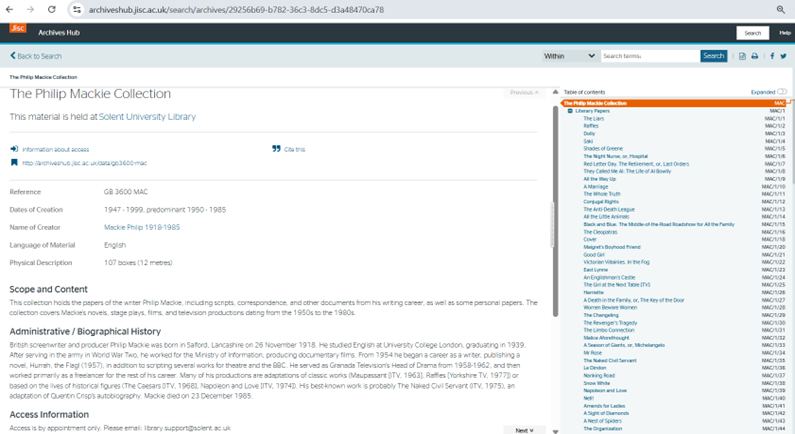
Figure 1: The Mackie Collection in Archives Hub (http://archiveshub.jisc.ac.uk/data/gb3600-mac)
I concluded by emphasising the role of standardised metadata and I noted that cataloguing the Mackie Collection has resulted in greater online visibility, wider engagement and international research interest.
In the second presentation, Andrew Dove, the Digital Systems Librarian at the Natural History Museum, discussed “Improving the Discoverability of Archive and Museum Collections.” He explored how archival and primary museum collections can be integrated within discovery systems, such as Calm, Alma and Primo VE. Dove highlighted the shift from OAI-DC harvesting to custom XML imports, mentioning the implementation of Alma normalisation rules to make fonds, series and item-level records searchable facets.
Day Two: 12 November 2025
The second day focused on how digital infrastructures and artificial intelligence are transforming archival research and access, bringing together publishers, content providers, and researchers. Frans Havekes (De Gruyter Brill) opened with “Supporting Archival Research by Providing Metadata and Advanced Search Options,” highlighting Brill’s efforts to digitise and enrich historical collections through enhanced metadata and advanced search functionalities, while addressing challenges with OCR accuracy with manual quality checks.
Chris Houghton, Head of Academic Partnerships at Gale, followed with “Context is Not a Keyword: Rethinking Discovery for Humanities Research.” He examined how discovery systems can oversimplify archival materials, emphasising the importance of context, provenance and ethical framing, especially in historically biased collections and urged libraries to measure success through meaningful scholarly engagement rather than raw usage statistics.
The final presentation, “Using AI to Improve Access and Enhance Discovery Capabilities in Archival Collections,” was delivered by Sonia Yaco, Emerging Technologies Librarian at Rutgers University. Drawing on her collaboration with Durham University, she demonstrated how new AI tools were applied to their archival collections to improve accessibility. Yaco outlined three strategies: improve readability with handwritten text recognition tools, gain insights through text analysis and named entity recognition for key entities and relationships and connect text and images by using generative AI for photo metadata.
The seminar highlighted how metadata, discovery interfaces, collaboration and AI-driven innovation are transforming the discoverability and scholarly utilisation of archival collections and primary sources across libraries, publishing, content providers and museums.