
31 October 2025
Emma Watkins, Head of Marketing & Communications, 67 Bricks

One of the best parts of the scholarly ecosystem is the wealth of smaller and society-based publishers which serve specialised communities. Those publishing houses have been facing many challenges, but one – Bone & Joint – are using AI to transform the ways they are delivering knowledge to their community. Their story is a lesson in how new technology can create an opportunity for companies and institutions with minimal resources to have real impact and deliver on their promise of the dissemination of knowledge.
Bone & Joint have been undertaking a huge digital transformation, re-platforming their journals, building new authoring tools and creating a new educational product to serve their unique community of orthopaedic surgeons. They are a small company, but that size has led them to be agile and innovative in the ways they are approaching the future.
During their customer research, one issue kept being raised. For anyone working in scholarly publishing, it’s a familiar complaint – the number of papers being published keeps increasing, and staying on top of the most important work is near impossible. This issue was particularly acute for their community – surgeons are famously time-poor, but they also depend on the latest research for best practice in their own work.
One thing the surgeons weren’t asking for was more material to read – even short summaries or round-ups of research would require them to take time out of their day to sit and concentrate. They wanted an audio version.
The GenAI opportunity
The team at Bone & Joint were not new to podcasting. They already produced a popular monthly podcast, but it was too resource intensive for the small team to scale. However, with the launch of new GenAI tools and a partnership with 67 Bricks, expanding their audio output was suddenly within reach.
67 Bricks built a custom tool that enabled them to turn complex research papers into short podcasts (most are around 4-5 minutes long), where two ‘hosts’ discuss the paper and its findings. Accuracy is key for this audience, so they developed an approach that could be directly integrated into existing content workflows and kept a ‘human-in-the-loop’ at two stages in the podcast generation (for quality control). The papers selected for the podcast are hand-picked by journal Editors-in-Chief, ensuring that they are always of the greatest interest to the orthopaedic community.
The tool works as follows:
- An editor uploads a pdf or website URL source, and at that point can specify branding guidelines.
- Text is extracted and the podcast is then planned using AI (including: which points to cover, the structure of the discussion, opening and closing statements, specific results to highlight).
- Dialogue is generated and additional prompts can be used to ensure correct style and pronunciation. At this point, any part of the text can be amended by the human editors.
- It is then fed into a text-to-speech provider, and the podcast episode is created.
It takes the team approximately 30 minutes to generate each episode, offering an excellent return on their time investment. Even better, the reception has been incredibly positive.
In addition to human-in-the-loop quality control, there is a custom dictionary that ensures all the medical terminology is pronounced correctly. This is simply not available on any of the off-the-shelf tools on the market, and was specially developed by 67 Bricks and the Bone & Joint team.
What about privacy and copyright?
Retention of copyright and data security was front of mind for Bone & Joint when embarking on building this new tool. There certainly are plenty of tools already in existence which can create podcasts based on written content – NotebookLM for example. However, it did not sit well with the team that by working with these off-the-shelf solutions they would be handing over their proprietary data, potentially losing sight of ongoing usage of that content for other purposes. The tool they have developed, therefore, works on a closed system. No data is passed back to any third parties, and the authors retain their rights.
What’s the impact for Bone & Joint?
AI Talks has been publishing episodes since November 2024, and episodes have been downloaded on every continent. The highest usage is naturally within the US and UK, aligning with their core community, but the global reach is an excellent indication that altering the format supports wider dissemination of the published work. As expected, the podcasts are also mostly being listened to on mobile devices, again demonstrating a different user behaviour to the written articles, which are mostly accessed on a desktop.
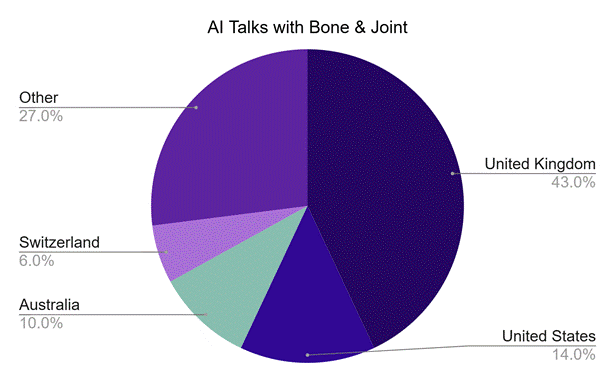
Chart showing locations of listeners
Impact
For the community, an offering like this is hugely beneficial and the feedback has been very positive. Each episode is sent to the original article’s corresponding author for consultation on accuracy, as well as feedback on the listening experience; the following quotes reflect not only an appreciation of the tool’s accuracy, but its ability to make the summaries enjoyable:
“Brilliant. I was thinking this summarizes our papers better than I often do when creating a presentation. I thought the content was well constructed and conclusions appropriate”. S. MacDessi
“The proposed podcast got very positive feedback from all the coauthors. Impressive work!”. P. Wahl
“I enjoyed listening to the podcast. The paper itself is well summarized there”. M. Salzmann
“The podcast sounds very natural and professional. The content is accurate and it is presented in a very easy going manner. I wouldn’t change a thing”. H. Aguado
“Amazing. Really enjoyed it”. A. Duckworth
In scholarly publishing, maintaining relevance and adapting to disruption is critical, and these new podcasts offer a way to engage a generation of users who are moving away from traditional modes of information engagement, without overburdening already-stretched editorial teams. The podcast tool has produced episodes across two very different Bone & Joint titles (Bone & Joint Open and Bone & Joint Research), showcasing its versatility by covering an impressive array of orthopaedic specialties. The ‘discussion’ between the AI hosts feels like just that: a cordial conversation that reframes complex results and analyses with clear and accessible language, which appeals to native and non-native English speakers alike. If you’re curious, you can take a look here.
What’s more, this sort of experimentation opens the door for repurposing all kinds of written content into new user experiences, better serving the orthopaedic community and broadening Bone & Joint’s horizons. Of course, the possibilities here extend beyond journal dissemination. Any text can be turned into audio content – widening participation and accessibility for any institution, including libraries.
| These views are the authors’ own and do not necessarily reflect the views of UKSG. |
| This UKSG Editorial is taken from the community newsletter UKSG eNews, published every two weeks exclusively for UKSG members. The newsletter provides up-to-date news of current issues and developments within the global knowledge community. To enjoy UKSG eNews and other member benefits become a UKSG member. |
https://www.uksg.org/newsletter/uksg-enews-597/