
11 Jul 2025
Lesa Ng
In 2020 (!) I was the John Merriman Award winner and would have attended UKSG in Brighton. This year, due to UKSG widening their bursary criteria, I was really pleased to be given the opportunity to finally come to Brighton on a sponsored place.

Day 1
Before the conference opening, I had intended to walk around the exhibition booths but baulked when I got overwhelmed. I decided to leave the cuddly toy conference swag hunting until later.
There was a recent trend where people used OpenAI’s generative AI to Ghibli-fy images in a manner that totally goes against the ethos of Studio Ghibli’s co-founder Hayao Miyazaki. In early April, authors protested at Meta HQ in response to Meta’s alleged use, without permission or payment, of pirated works from LibGen to train their Llama AI. So, I went into the opening plenary with a slightly cynical and Luddite-esque attitude on the use of AI but fully expecting the speakers to convince me otherwise.
Questions in the Q&A echoed my concerns:
- “How sustainable is it for companies to churn out Al tools? Is it worth the environmental cost?”
- “Can Gen Al ever be considered ethical when its foundations, current and arguably future growth is all based on and dependant on intellectual property infringement?”
- “How do you see the effect of the unstable state of global politics and the rise of the tech billionaires’ influence on Al in academia? And where do you see the Libraries’ role?”
It would have been great if the speakers had addressed these concerns rather than dismissing them as coming from AI illiterate village idiots.
I love anything to do with metadata, cataloguing, and discovery so of course I attended the talk ‘From Cataloguing to Discovery: a journey of innovation and resilience’.
I was pleasantly surprised by University of Leeds’ development of their Metadata Team from traditional book in hand cataloguing to doing things differently, with a focus on a people-centric approach. Often, I have seen cataloguers viewed, derogatory, as ‘data entry monkeys’. Metadata is more than data entry – it is about discovery and their approach reflected this.
I was particularly impressed by their creation of a supportive learning environment with dedicated distraction free learning time, giving people a sense of ownership over areas of expertise, shared reading, regular updates on each team members’ work, and providing support for the next person to do the training already completed by another team member.
‘Evaluating Rights Retention, almost two years on’
University of Aberdeen, being an early adopter of a Rights Retention (RR) policy are now evaluating the effectiveness of the policy and their outreach activities around it. This was an informative session, giving those of us who have yet to implement a RR policy to learn from their experiences and use the strategies that worked for them.
UKSG organised a photo opportunity and this was a lovely chance to meet some of my fellow award winners. I walked around the exhibitors with Lorna Goudie afterwards and it took away the awkwardness of attending as an independent delegate with no purchasing power. I did however appreciate the vendor, who when I said I had no purchasing power responded with “but you might do in the future” and gave an enthusiastic talk about their service.
Day 2
‘Empowering Neurodivergent Staff, Learners, and Researchers: The Library as a Partner in Success’
As an ADHDer, this plenary was deeply personal to me. I was grateful to each panel member for sharing their personal experiences of being neurodivergent within the workplace. As I said to Andrew afterwards, I was nodding along throughout, feeling seen and realising I’m not alone. I especially appreciated the padlet of links to accessible tools, resources, online tutorials, and guides, as well as the opportunity of having questions answered after the session ended. I noted that the peer-to-peer support networks and buddying mentioned was what I was doing yesterday at the exhibition viewing with Lorna.
Day 3
‘Beyond the Stacks: A Sneak Peek into Library Staff Engagement with Job Shadowing’
The University of Nottingham Libraries Training and Development Team Libraries Job Shadowing scheme is something other workplaces should aspire to putting into place at their institutions. Noticing that for some staff, career progression was difficult and that they were losing talented staff because of this, the scheme sought to address some of these issues. The job shadowing provided a simple but effective way to upskill staff, improve staff engagement, and promote cross team collaboration. The speakers were particularly pleased to report on staff who successfully applied for internal jobs that they would not have done previously as they thought they did not have the skills to do it.
‘Stopping Short of the Goal: Is Open Access Really Fulfilling Its Promise to the Public?’
The closing plenary looked at the accessibility of research to the public beyond open access. Many of us, unfortunately, know of loved ones who have been diagnosed with cancer or other illnesses and have wanted to find out further information about it but papers being freely available is just one way to access this. For research to be truly open access it needs to be presented in a way that the general public can understand. For example, lay abstracts and summaries or narrative CVs that explain why a paper is important in lay terms. Another example is to explain the impact of research into therapeutic therapy for cancer – that it does not necessary mean this will be an available treatment in the next two years but that it will lead into the next stage of research.
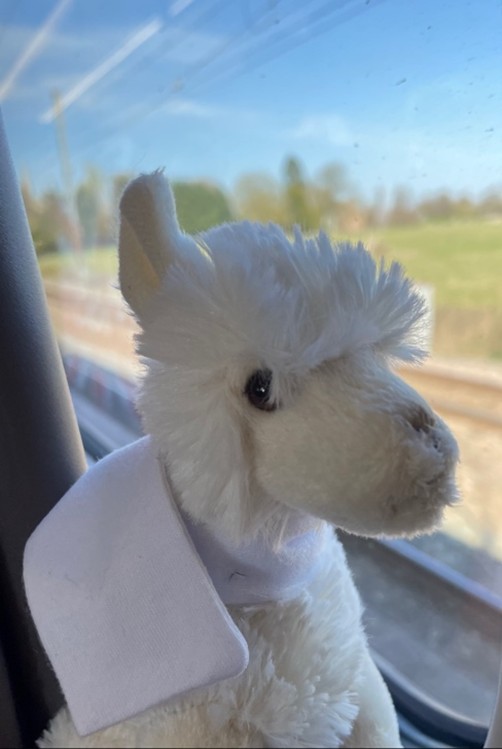
Unfortunately, I had to leave before the Q&A and closing but not before I picked up this (as yet unnamed) llama from Sage.
My conference playlist
Brighton Rock by Queen
A Design for Life by Manic Street Preachers
Glass Ceiling Feeling by Lady Parts
Break My Soul by Beyoncé
And Here I Stand by Skunk Anansie
Killing in the Name by Rage Against the Machine (IYKYK)
珍惜再會時 by Anita Mui
Movement III. With Silence by Erland Cooper