
15 May 2026
Olivia Edmonds and Tarandeep Johal, University of Wales, Trinity St David

As digital access becomes the norm, libraries everywhere are reassessing the footprint of their print journal collections. Our institution recently began this journey—an ambitious effort to reclaim space, improve access, and rethink long‑term collection strategy.
Background
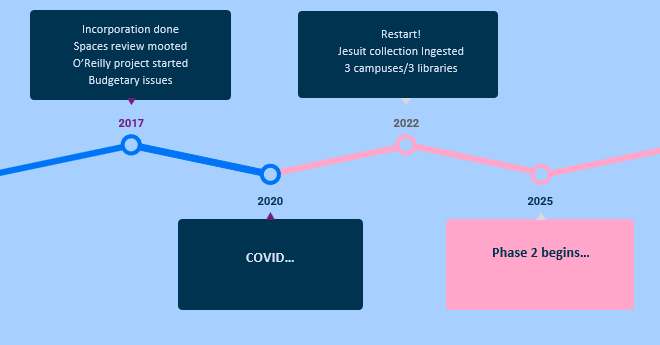
The transformation of Dublin City University (DCU) Library from its humble beginnings in temporary accommodation in the 1980s to a three-campus library is a complex journey of unifying diverse collections while modernizing student spaces. This evolution was significantly accelerated by the 2016 incorporation of St Patrick’s College, the Mater Dei Institute, the Church of Ireland Institute of Education, and the later ingestion of the Milltown Institute collection, which left the library with the considerable task of consolidating five distinct collections into three locations.
Drivers of the Spaces Review
The primary catalyst for the “Spaces Review” was the extreme pressure on physical shelving following incorporation. In locations like the Cregan Library, shelves were overflowing to the point that journals were being stored in boxes, office shelves, and even in the café area. Simultaneously, there was an emerging student need to reimagine library spaces to provide more flexible, modern learning environments. To balance these competing needs—preserving academic resources while opening up space—the library initiated a systematic audit of its print journal collections.
Phase 1: Current Subscriptions – Relocating with Purpose
A Detailed Inventory Reveals the Scale
Working closely with the Research and Teaching team, we launched Phase 1 at the O’Reilly Library. We began with a full inventory of our print journals, creating a master spreadsheet that captured every title and issue—whether on shelves or in our Library Management System. The results were striking: 2,873 titles stretched across nearly 2 miles of shelving, making the need for change unmistakable.
Checking the Digital Landscape
Next, we analysed online availability, reviewing local subscriptions, consortial packages, post‑cancellation access, and potential digital archive purchases. These findings, combined with our print data, gave us a clear picture of what could move, what needed to stay, and what might be replaced by digital access.
The library established clear policies for physical shelf management to maintain a balance between accessibility and space-saving:
- Open Shelf Policy: Only the most recent three years of print subscriptions are kept on open shelves.
- The Request Collection: Back issues are relocated to a “Request Collection” or periodicals store, moving them off the main floor while keeping them available for researchers.
- “1 Year Down – 1 Year Out”: A rolling policy ensures the collection remains lean by systematically moving older volumes to off-site storage as new ones arrive.
The Move: Complex but Coordinated
The physical relocation required careful coordination with our Public Services and Outreach team. Space constraints, oversized volumes, and an unexpected batch of unsolicited Legal Deposit materials complicated the process—but a methodical, team‑driven approach kept the project on track.
Opening Up New Possibilities
So far, more than 500 meters of shelving has been freed – space that can now be transformed into collaborative, student‑focused areas. It’s a promising start, even if only a fraction of the nearly three‑mile print collection.
Phase 2: Into the mists of time
Now that the current subscriptions have been honed into a lean collection, we turn our attention to the remaining print titles. These are ones that have been cancelled over many years in favour of online, either locally switched to an e-subscription or as a result of expanding consortial collections, which allowed for print cancellations and corresponding savings without losing access to content. There are also a large number of non-current legacy cancellations that had just never been removed from the open shelves.
These ‘Phase 2’ titles will be reviewed in collaboration with our Research & Teaching colleagues for decisions on retention, relegation and disposal. One of the challenges will be how to dispose of those titles no longer deemed relevant to curricula.
A Sustainable Approach to Disposal
And that’s a question no one enjoys facing: What do we do with all the unneeded volumes of previously cancelled titles? With potentially hundreds of bound and loose issues and no spare storage, disposal is necessary, but the question remains, how?
DCU Library makes every effort to ensure material is disposed of in an appropriate manner and (in keeping with DCU’s Climate Action Plan 2021-2026) actively promotes sustainable models for disposition. Any books being withdrawn from our collection may be sent to support global literacy programmes via organisations such as Better World Books. Material not redistributed in this way will be sent for recycling to companies such as Great White, who, for each ton of shredded material will donate €1 to the One Tree Planted programme, turning the process into an opportunity for environmental contribution.
The Home Stretch
The impact of Phase 1 has already been transformative. But this progress is just the beginning, with Phase 2 already initiated, we look forward to reclaiming even more space for bright, collaborative, student-friendly areas.
| These views are the authors’ own and do not necessarily reflect the views of UKSG. |
| This UKSG Editorial is taken from the community newsletter UKSG eNews, published every two weeks exclusively for UKSG members. The newsletter provides up-to-date news of current issues and developments within the global knowledge community. To enjoy UKSG eNews and other member benefits become a UKSG member. |