
29 May 2026
Author: Ellen Brown, Learning Development Tutor in Creative Arts Education, University for the Creative Arts (UCA)

As a Teaching and Learning Lead and creative education specialist with an interest in open access, I often consider how digital collections move beyond repositories of knowledge to become active tools for learning. The Zandra Rhodes: Colourful Heritage project offered a valuable opportunity to explore this in practice: how an open digital archive can support skills development, widen participation, and connect learners across diverse educational contexts.

Delivered in partnership between the University for the Creative Arts (UCA), Zandra Rhodes Studio, and the Zandra Rhodes Foundation – and funded by the National Lottery Heritage Fund – Colourful Heritage focused on the digitisation and cataloguing of garments, drawings, accessories, and oral histories from Zandra Rhodes’ archive. While these outputs were significant, the most meaningful outcomes emerged not from preservation alone, but through teaching practice, collaboration, and learner engagement.
Digitisation is often treated as an endpoint: collections are photographed, catalogued, and made available online. This project challenged that assumption by positioning the digital archive as a teaching resource in development. This pedagogical framing shaped decisions throughout – from metadata creation to dissemination – and ensured the collection was designed for use, not passive consumption.

One of the clearest insights came through collaborative cataloguing. Bringing together library staff, academics, creative practitioners, and non-specialist users exposed the tension between technical precision and discoverability. A term such as “cobalt” may be accurate, but it risks excluding a learner searching for “blue”. From a teaching perspective, metadata is not neutral; it forms part of the learning interface. Expanding descriptive language improved accessibility without compromising professional standards, highlighting the value of user-centred approaches within scholarly infrastructure.
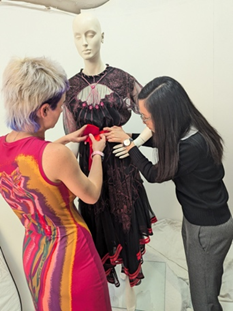
The project also demonstrated the potential of archives as sites of authentic, work-based learning. Four UCA students undertook internships at Zandra Rhodes Studio, contributing to the preparation, restoration, and digitisation of garments. Structured to mirror professional practice – from competitive recruitment to studio workflows – these placements developed technical expertise, confidence, and an understanding of heritage as both material and contemporary. Three of the four interns have since progressed into fashion industry roles, including one now employed by the studio, underlining the value of embedding employability within digitisation projects.
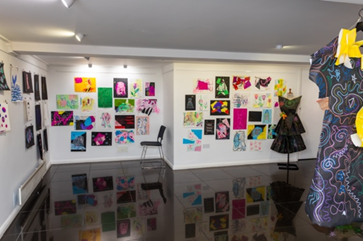
Equally significant was the Schools’ Outreach Programme. Working with 16-18-year-olds from Medway, where Zandra Rhodes grew up, the project combined access to the digitised collection with structured creative practice and on-campus engagement. Students engaged with the archived digital collection, newly recorded oral histories and through a daily #DrawEveryday social media campaign (which can be found in the project Instagram highlights) before attending workshops at UCA and exhibiting their work at The Halpern Gallery in Chatham, Medway.
What stood out was how quickly digital heritage became personally meaningful. Students moved from seeing heritage as distant and institutional to recognising it as connected to their own lives and communities. Teachers reported increased confidence, creative discipline, and aspiration among participants, alongside shifts in their own teaching practices through the use of open resources.

For many, this was a first encounter with higher education in a creative context – demonstrating how open collections can support widening participation when paired with thoughtful learning design.
The project was delivered during a period of significant instability across the UK higher education sector, with financial pressures and restructuring affecting institutions nationwide. While these challenges constrained some planned legacy activity, they also underscored the importance of partnership and shared infrastructure. Collaboration between a university, a creative studio, and a charitable foundation enabled the creation of sustainable, openly accessible resources that will continue to support learning beyond the project’s lifespan.
From a scholarly communication perspective, the most enduring outcome of Colourful Heritage lies not in the scale of the digital archive, but in how it
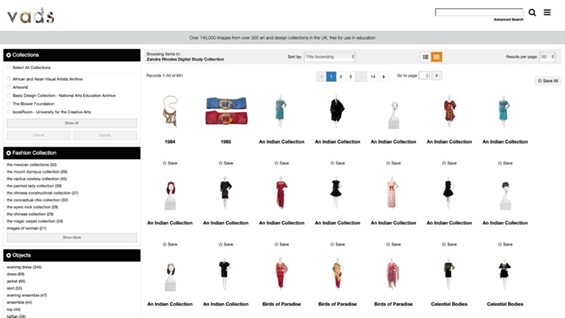
has been activated. Interns developed industry-relevant skills through direct engagement with heritage materials. Students built confidence, creative identity, and a sense of belonging within higher education spaces. Researchers and educators worldwide accessed the collection as an open teaching and research resource, often encountering UCA’s Visual Arts Database Service for the first time through the project.
For those working in libraries, archives, and scholarly communication, Colourful Heritage offers a timely reminder: open digital collections are not passive assets. When designed with teaching and learning in mind, they can drive skills development, widen participation, and challenge assumptions about who heritage is for. As institutions navigate ongoing financial and structural uncertainty, pedagogically driven digitisation – grounded in collaboration and openness – remains one of the most effective ways to ensure collections are not only preserved but actively used.
Digitisation safeguards the past. Activation, through teaching and learning, ensures heritage shapes the future.
You can find out more about The Zandra Rhodes Colourful heritage project here: www.uca.ac.uk/colourfulheritage
Access our free toolkit to support teaching and learning here: https://mylibrary.uca.ac.uk/colourfulheritage-toolkit
Read our Evaluation report here: https://mylibrary.uca.ac.uk/colourfulheritage-evaluation
Linkedin: www.linkedin.com/in/brown-ellen.
| These views are the authors’ own and do not necessarily reflect the views of UKSG. |
| This UKSG Editorial is taken from the community newsletter UKSG eNews, published every two weeks exclusively for UKSG members. The newsletter provides up-to-date news of current issues and developments within the global knowledge community. To enjoy UKSG eNews and other member benefits become a UKSG member. |