
4 February 2026
Read the full Scholarly Kitchen blog post here
Charlie Rapple, Kudos and Chair, UKSG
SNIPPET

Open wide and say “aaargh”: we’re going to talk about the Crocodile Effect. You’ve probably heard of it already, even if you don’t recognize the term. It is the biggest threat currently faced by scholarly publishers, and yes, I know that’s an audacious claim given the research funding crisis, peer review crisis, research integrity crisis, and all the other crises of the day. Yes, I’m talking about “Google Zero,” “zero-click search,” “On-SERP fulfillment,” “walled-garden search,” or the many other terms that are bandied about to describe users getting answers directly from search engine results pages (SERPs), rather than clicking through to source sites such as journal articles.
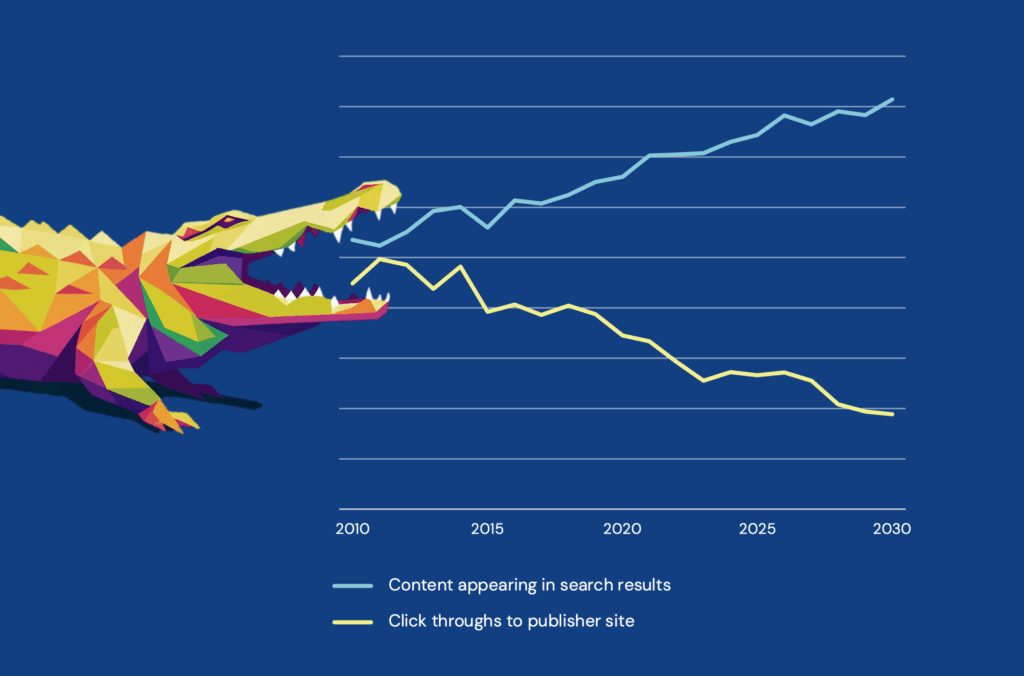
The term “Crocodile Effect” derives from a LinkedIn post by SaaS marketing expert Tim Soulo: “The past 12 months of GSC [Google Search Console] data for the Ahrefs Blog [his website] look like a crocodile. And I’m pretty sure you’re seeing the same crocodile in your own GSC.” That is to say, the Crocodile Effect is the gap between impressions of your content in search engines, and click throughs to the full text on your platform.
Eating our traffic
The Crocodile Effect has grown hugely since the addition of AI-generated knowledge panels on search pages (discussed by Stephanie in a post in December) and is the central USP of new “AI web browsers” like Perplexity, or OpenAI’s Atlas. Publisher search results are pushed down the page, and although they may appear in the side bar offered alongside knowledge panels, they may be shown further down the list than more answer-oriented or news-driven content. Content impressions continue to rise because the content is being ‘shown’ — but fewer users click through to the full text on your website, creating a threat to any organization whose business model relies in usage as a metric of customer success. This includes scholarly publishers — whether the customer is an institution paying for a subscription and expecting to see lots of downloads by their users, or an author paying an APC and expecting to see lots of reads. Fewer site visits puts revenue at risk by weakening publishers’ renewal negotiations or reducing author retention. Low traffic is also likely to reduce citations and brand awareness, undermining publishers’ vital role and reputation. Publishers have spoken at conferences about the drop-off they’re seeing (OUP’s John Campbell told last year’s London Book Fair that he attributed a 19% drop in click-throughs to their academic reference content to zero-click search; one October 2025 study shows that over half of Google searches now end without users leaving the search engine results page 😱. As Dariusz Jemielniak puts it in his recent Nature article (thanks James Butcher at Journalology for drawing my attention to it, and for this excerpt), “When AI chatbots provide seemingly authoritative responses drawn from Wikipedia’s very pages, why would anyone navigate to the source, let alone contribute to it?”
Read more about Threatening Research Integrity and Transparency and What Can We Do About It? https://scholarlykitchen.sspnet.org/2026/02/04/responding-to-the-threat-of-zero-click-search-and-ai-summaries-how-do-we-tame-the-crocodile