
30 May 2025
Hattie Griffiths,Teaching Collections Team Leader, The University of Manchester Library
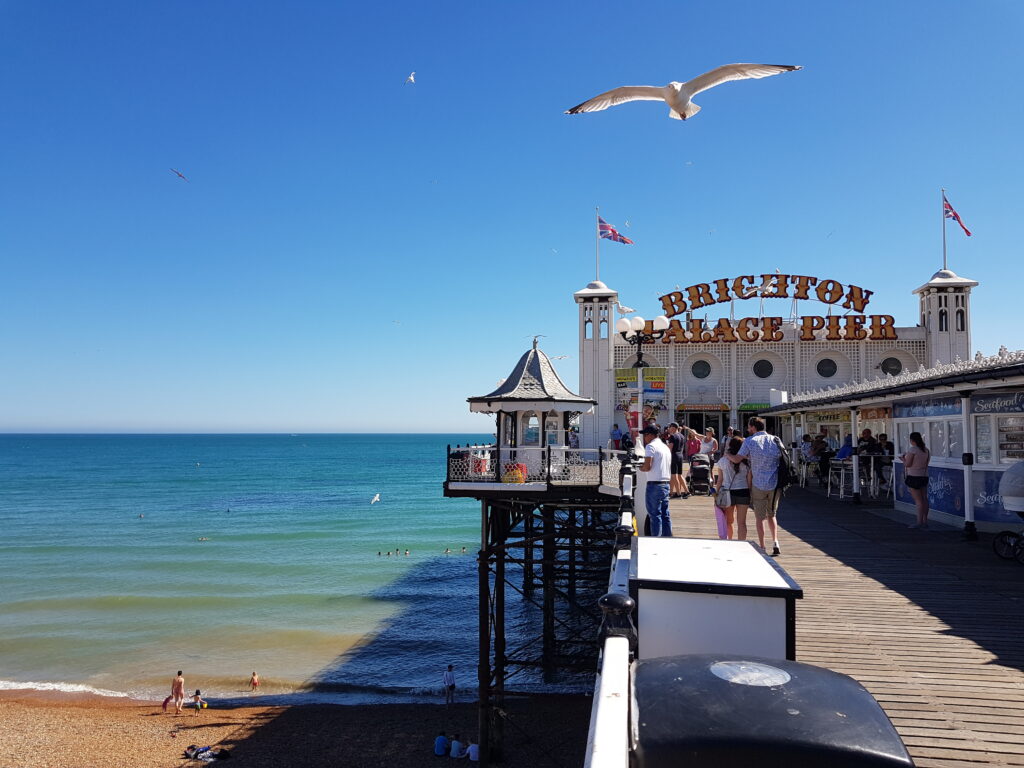
Brighton was a stunning backdrop for UKSG this year. As a Northerner who has never been further south of the country than Cardiff, I was very much looking forward to the prospect of exploring a new seaside city. We could not have been luckier with the weather too – the sea views and sunshine formed a perfect frame for the week’s festivities.
Conferences, and conferencing, seemed daunting to me as a neurodivergent first-timer. The portrayals I had read about in books, or seen on the TV, were not the most reassuring. The conferences I had seen were dull, drab, and held in claustrophobic convention centres or in equally drab airport hotels. There was also the challenge of networking; how do people initiate conversation with each other? Does one immediately launch into an in-depth description of their job role? Their career achievements? Or is it a gradual back-and-forth that begins with your pet, your institution and your shoe size? I prepared myself mentally with some fun facts about myself to whip out if necessary.
The First Timer’s reception, strangely, was among the events that I looked forward to the most. I say strangely, as the event was not particularly UKSG focussed – more a social opportunity that gave first timers the advantage of meeting and chatting to other new faces without the larger scale pressure of a busy conference bearing down on them. It was encouraging for me to know that I would be cautiously mingling in a room full of other newbies, some of whom would be my fellow award winners.
As I walked from the hotel after arriving and freshening up, I took in the spectacular view of the Brighton seafront, making sure to duck if a seagull dared to get too close. Upon arriving, I was given a drinks voucher and set loose! I got chatting in the drinks queue to a lovely colleague who had come down from near Cambridge, and from then we both tag-teamed introducing ourselves to the other small clusters of information professionals that were gathered.
I garnered that the most effective way to network was to simply say ‘hi’, with a short ice breaker such as ‘I love your tie!’ or ‘isn’t the seafront beautiful today in the sun?!’. The least effective manoeuvre, I found, was saying ‘hello, I’m mingling, I’m Hattie and mingling, hello!’ which tended to take people aback more than anything. So, in many ways, the first timer’s reception was a great way of easing into conference social etiquette, in addition to getting to meet some fantastic colleagues in a relaxed setting. I met people who had travelled from Liverpool, Galway and even Karlstad in Sweden. I even managed to connect with a couple of fellow award winners, which was fantastic as we swapped details and continue to keep in touch even after the conference.
On Monday, the conference began. I am happy I took notes throughout, as being able to watch and question information colleagues, who are seen as experts in their field, was a fantastic experience. The first plenary with Alan Oliver, Kate O’Riordan, Leo Lo and Charlie Rapple was fascinating, particularly Kate’s almost exasperated rhetorical question mid-way through the session; ‘How can AI even be ethical when its very foundation is built on intellectual property infringement?’ eliciting a big cheer from the audience. The excitement was further amplified when Charlie whipped out ChatGPT on her laptop to give its opinion on its own existence.
Another session I really valued was Vanessa Farrier’s breakout – ‘Exploring the Link between Inclusive Library Collections and Student Success’. Being a Teaching Collections Team Leader focussing on reading lists, and often working closely with Acquisitions, widening our offer and encouraging academics to diversify their reading lists is something I am passionate about, so Vanessa taking us through KCL’s ‘Find Yourself in our Collection’ programme with making their collection expansion a collaborative effort involving students as well as colleagues and academic staff, was inspirational.
For Monday, I must also give a special mention to Cristina Rusu and Ayesha Thompson’s ‘Beyond the Stacks: A Sneak Peek in Library Staff Engagement with Job Shadowing’. Their presentation giving us a step-by-step insight into building a cross-departmental workflow and offering development opportunities to colleagues and students was a great insight into how we as HEIs can widen opportunities to benefit both shadowees and job hosts in gaining a unique perspective on Library career prospects- and how differing work experiences can be an advantage to workplaces, rather than a drawback.
Despite planning on going to the evening quiz, I elected instead to stay in my hotel room as I was socially completely drained. Perhaps in the future there could be scope for a more relaxed drop-in/drop-out evening plan of some kind that would be more neurodivergent friendly. I would love to have a part in planning this if ever given the option, as this is another passion of mine.
After a solid breakfast at the Travelodge with lovely award winner Olivia, where she regaled me with her tale of winning (by losing?) the coveted last-place wooden spoon at the quiz the night before, I set upon the Brighton Centre with my brain refreshed and my face re-sunscreened.
Following the opening plenaries around cyber-security and open research, both of which were very interesting to learn about from my less educated perspective, I went to a Q&A session with Clarivate, not knowing what to expect. What we received was nothing short of a very long apology and explanation for the way their recent announcement regarding Proquest was communicated, with an additional push for everyone to jump on the Rialto train. Their speakers – various members of the Clarivate UK sales team – were incredibly patient and gave the impression that they understand the turmoil that they have thrown smaller institutions into, however I found their attempts to plug Rialto further in a room undoubtably full of bemused customers to be in slightly poor taste. I did appreciate, however, the effort they are making to collaborate with their critics – for example SCONUL, in response to their open letter.
My favourite session of the day, and indeed the whole conference, was ‘Empowering Neurodivergent Staff, Learners and Researchers: The Library as a Partner in Success’ in Auditorium 1. I was so inspired by Josh Sendall, Caroline Ball, Jo Fitzpatrick and Andrew Walsh’s talk covering their own lived experience that I have been consciously changing the way I work to embed their message and ideas into my day-to-day life. On a personal level, when previously I was quite ashamed of my diagnosis, or rather, I saw it as a potential hindrance to managing my team effectively, I have been shown by these inspirational colleagues that having a brain that is wired differently can be an incredible asset to my role, and indeed to the Information Sector in general. Since I have returned to work, I have mentioned to my team for the first time that I am neurodivergent (casually in conversation, but it felt like a big step!), I have signed up to some colleague mental health events, become part of the Library’s Staff Wellbeing Planning Group, and am intending on joining NLISN as soon as possible.
I am very grateful that I had the opportunity to attend this conference, I have learnt so much about the sector as well as myself. The grey perception I had of conferences has been wiped clean and replaced with fabulous memories of inspiring colleagues, enlightening breakouts and questionable moves on the Przym dance floor! I wish I could list everything I attended and enjoyed, but that would take up thousands more words. Thank you again.