
Rebecca Wells, Library Assistant, Liverpool Hope University
Monday 31st March

Plenary session 1
Navigating AI Futures: overview – Leo Lo
I went into this session with a basic knowledge of AI and my own preconceived notions. I will admit that I have a negative view on the whole topic and a concern for the direction and implications. Leo laid out what he believes to be the 4 possible scenarios when looking at from an intersection of the extent societal adaptation with the extent of intentional AI design. I think the two more “positive” scenarios he laid out where there is a high adaptation are, unfortunately, highly unlikely. It was nice to learn about the signs that point towards the more positive scenarios, especially the increased push for ethical standards, but I am unsure that I have much faith in it. I did find this presentation very interesting and I have to agree with Leo’s overview that scenarios 2 or 3 are the most likely options or some combination of the two, with low adaptation and varying levels of design/control.
AI for Academia – Kate O’Riordan
The presentation from Kate really highlighted a lot of the concerns I have about AI use in academia, and I was especially interested in the idea that a lot of the current effects are contradictory. She raised a point about the positioning of universities and students as consumers, and I think that the effect of this can be clearly seen from the number of companies pushing AI products towards libraries. She also had some interesting points on how the issues that are now appearing can be addressed but stressed the need for collaboration which I think is paramount. Without the collaboration AI will learn on closed feedback loops and we also may lose jobs and people from within the field as they are left behind.
The Library CEO: Managing Politics, Technology and Talent as the New Paradigm – Tony Zanders, Jessica Gardner, K Matthew Dames
This was one of the sessions I was most excited for, I am quite an ambitious person so to be able to learn about the careers of those high up in the library and information sphere felt very useful. The discussion was very enlightening, especially regarding what they consider the most useful skills/experience and I really appreciated Jessica taking the time at the end to answer a question I had. Tony actually sent me a chapter he and Matthew had worked on relating the talk and I am looking forward to reading it and reflect on what it says.
COUNTER-intuitive: up close and personal with usage metrics – Tasha Mellins-Cohen, Beda Kosata
I handle usage statistics in my job so I went to this hoping to pick up some tips. Tasha was very informative and demonstrated a useful method on the use of pivot tables to make the most out of master reports which I am looking forward to trying out. Beda’s demonstration of Celus as a COUNTER API tool was interesting but as it is not something we currently use and are unlikely to acquire I found this portion less useful. Maybe later on in my career it will be something I am able to utilise.
Beyond the Stacks: A Sneak Peek into Library Staff Engagement with Job Shadowing – Ayesha Thompson, Cristina Rusu
This was another talk I was very excited about. I think this could be a very useful practice that could be beneficial to universities of any size not just the larger ones like Nottingham where it was trialled. The process that was laid out was so useful as it meant that as a scheme it would be very easy to replicate. I think this would benefit my institution tremendously as even as a small staff they are pockets of misunderstanding about roles and responsibilities, and with a high influx of new/younger staff the career progression impacts would be amazing.
Tuesday 1st April
Plenary Session 2
Cyber Security and the Academic Library: What to Be Worried about and What to Do – Rick Anderson, Heather Lowrie, Susie Winters
I didn’t have a lot of knowledge about this topic prior to the session, only how an attack affected the British Library and the ILL scheme. The methods of attack identified were both fascinating and worrying and helped me further appreciate the work that goes into securing library and publisher data. The Q&A session was particularly enlightening with panellists’ tips that can help prevent attacks or mitigate the impact. I found a question on the mental health impact on staff very interesting as it wasn’t something I had considered before. My main takeaway from it was similar from the first plenary – that without trust and collaborative work we will struggle to move forward in a positive direction.
How to respond to a cyber-attack in the real world – Stuart Maxwell
This case study was very helpful for me as I understand concepts a lot better with real world examples. I learnt a lot about the recovery process following a cyber attack and went away with a much better understanding of the process from different viewpoints.
Shared responsibility (or failure)? Who should bear the burden of maintaining the integrity of the scientific record? – Sara Rouhi, Sarah Thompson, Rachel Bruce, Wei Mun Chan
This session ended up being a little bit different from what I expected. I hadn’t considered the issue about integrity from the effect of paper mills or redactions though I was aware of the effect of AI. I was disappointed that they ran out of time to discuss the effect that politics and censorship is having, which is what I originally though this was about. I luckily had the opportunity to discuss it briefly with Sara and Rachel after the session.
Stronger Together: creating a new regional consortium for collective licensing of e-resources – Phil Bower, Nick Skelton
I went into this session having no knowledge of how consortiums or collective licensing operated but left having a much better understanding. I think it is something that could easily replicated by other regions especially where I am currently based given that Liverpool alone has 5 HE institutions, and with the rest of the North west significantly more. This is something I would love to be involved in later on in my career and the speakers gave excellent advice to people who wanted to replicate the program.
The first year of Controlled Digital Lending at LSE – Wendy Lynwood, Kevin O-Donovan
This talk gave me a lot to think about. While there is a lot of legal barriers to getting it to operate more extensively, I think it would be worth it especially at smaller libraries with limited budgets. This is something else I would be interested in getting involved in at some point, although for now I will just have to consider the implications and possibilities. It would be especially interesting to see the applications of it in ILLs and the affect it would have on library usage statistics.
Wednesday 2nd April
Not just JUSP. Beyond the silos, making datasets sing to each other – Gavin Bridley, Will Peaden
This session had the biggest impact on me without a doubt. Part of my current role is managing and collecting usage statistics but this really helped me realise how limited we’ve been thinking in terms of presenting and utilising the data. I am planning on downloading PowerBI, which is a free tool, and learning how to use it so we can utilise what it does with usage statistics. The speakers did an amazing job of presenting the possibilities and how they use it, which really inspired me. The conversation we had after the session also really helped as it gave me a great starting point for this.
Academy-owned: Supporting scholars who are taking a stand for nonprofit, equitable, inclusive, and open alternatives to high-profit journals – Amy Harris Ryan, Kate E. Watkins, Caroline Edwards, Zoltan Dienes
I have very little knowledge about alternate publishing, so this was a good introductory session for me. I was already aware of some of the issues which is causing limited adoption of journal alternatives but it was interesting to learn about some of the solutions the speakers had in mind. I feel like I have a much better understanding of the topic after attending the session and I’ll hopefully learn more as the area develops.
Plenary 5
Stopping Short of the Goal: Is Open Access Really Fulfilling Its Promise to the Public? – Andrew Barker, Chris Box, Emma Yhnell, Marion Boland
I didn’t get much out of this session. I felt that some of the points discussed were rather obvious or repetitive from what I have heard previously, and that the question in the session title wasn’t actually answered.
Social
First Timers
I really appreciated this event on the Sunday evening. It allowed me to meet other people who got a sponsored place and also make some connections prior to the conference actually starting. It also meant that I could spot a friendly face during the day and had people to sit with during sessions and discuss what we had learnt. In particular I met someone during the event from Edge Hill University which is nearby and we are planning to (hopefully) meet up at some point.
Springer Nature dinner at the Royal Pavilion
I luckily got an invitation to this through my line manager. Usually someone in my position would not have had a chance to got to this so I am so appreciative of the opportunity. While the event itself was amazing, I really valued the connections I made. I got to meet and talk to a couple of librarians from Denmark, some of the Springer reps, and a government librarian. That last connection was the most interesting as I got the chance to learn more about other types of librarianship and discuss what their sector currently looks like.
Gala Reception
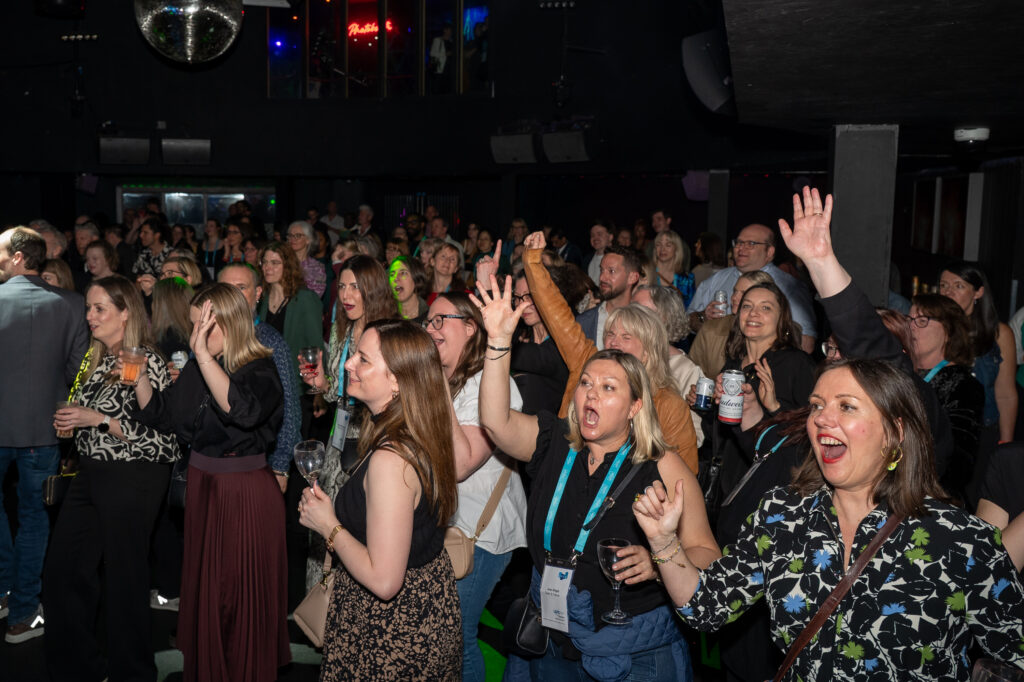
I didn’t have high expectations for this, and coming off of the second day I was exhausted and expected to only stay for an hour or so. Instead, I was blown away by the UKSG band and spent most of the night dancing with other delegates and some of the publisher representatives! I would highly recommend this to anyone going to the conference in the future.
Networking
While I did attend a lot of sessions, I made sure to make time to talk to a lot of attendees and publishers reps. With the attendees it was great to discuss the sessions content and learn about what their libraries are currently working on. It was especially interesting following on from Clarivate’s recent announcement to learn about what the response was and how they were planning on dealing with it. Given that I have no purchasing power a lot of my questions to reps were of personal interest, especially about the effect of Clarivate’s decision, and how they got to the positions they were in. Once of my goals of the conference to learn more about the paths open to me which I felt like I achieved. Overall I would say this was one of the most useful parts of the whole event.